What did you do when the lights went out? I was in downtown Richmond when Irene came to visit and watched with amazement as neighborhoods began to lose power. What was so amazing to me was the level of understanding that Richmonders had about our power grid.
The first blow was a tree falling on my neighbor’s house. It fell across an alley and landed in his upstairs, taking with it a tangled rat’s nest of wires and splintered telephone poles. I happened to be on the front porch when this happened and after getting over the initial shock of a blowing transformer and crunching timbers watched as one house went dark, and then the next, and then the next.
I managed to get out of downtown and into some of the other neighborhoods and the conversation was the same everywhere that I went. “Did you lose yours yet?” “I heard Monument is dark.” “They lost it on Patterson.” “Lights are still on at Libbie.” Everyone knew who had lights and who didn’t, and more surprisingly, everyone seemed to have a pretty good idea of when they would be left in the dark.
Another big body blow was the earthquake. Like many others, I felt the ground shake, saw the windows rattle, and watched the water splashing out of the ponds at the mall where I happened to be. It was interesting, to be sure. It was exciting. Don’t get to experience that very often here in Virginia. Then it became worrisome.
I started to see news reports of damage in Mineral and Louisa, which aren’t that far from Richmond. Then we got news of the shut down at the North Anna Nuclear Reactor. An unusual event had triggered a programmed response. No big deal, or so I thought.
A boater on the river just above the dam that day reported his boat rocking back and forth even though the water was like glass. After a few moments he noticed bubbles rising to the surface, and then the lake began to “boil”. He was in about 50 feet of water. Other local residents noticed a drop in the lake’s water level. A 22-inch drop. That’s about 8 billion gallons of water that just disappeared.
The cooling pond for the North Anna Reactor is Lake Anna. Lake Anna was created in 1972 with the clearing of land and the building of a dam on the North Anna River. Lake Anna currently covers about 13,000 acres with about 200 miles of shoreline. When the dam was built, it was designed to last somewhere between 50 and 100 years. It’s like a car: change the oil, do the routine maintenance, it’ll run forever. The Reactor at Lake Anna was designed to deal with hot Virginia summers, the occasional hurricane, and the possibility of an earthquake. A 6.1 earthquake. Our little rumbler was a 5.8.
All of this activity brought to light the fragility of our utility system. It got me to thinking pretty hard about our need for reliable forms of alternative energy and our commitment to clean, safe water.
A recent blackout in California that left over 5 million people in the dark and sweating was an “oops” moment in what was supposed to be routine equipment maintenance. That impacted people from San Diego, to Yuma, Arizona, to Mexico. A similar glitch in August of 2003 left 50 million people all over the East Coast without power.
When President Roosevelt regulated the energy industry in 1935 his goal was to provide safe, reliable, affordable energy to farms and factories, to families and fabricators, all over America. We owe him a debt for that but much of our grid today is from the 30’s or earlier.
We had over 250 water main breaks in Richmond last year and many of them where the result of aging pipes. Many of these lead pipes date back to the 40’s and 50’s. They follow the storm drains that clear downtown Richmond during a storm. Many of these drains and culverts date to the 1800’s. Do you remember Hurricane Gaston? These 200-year-old drains fed into a catch basin, which was supposed to pump the water into the James River. The Basin and pump were built in 1927.
 The American Society of Civil Engineers has a rating system for infrastructure. They are a group of almost 150,000 engineers nationwide who look at quality of construction, volume of use, age, visual inspection, and other factors, to determine the viability of roads, bridges, rivers, energy grids, water, waste, etc. Virginia rates a D+. Our roads and dams are a D-, our storm and wastewater processing rates a D+, our drinking water and energy structure is a C-, not a good picture. The highlight of our report card is a B- in parks and recreation.
They estimate that water rates and fees will increase 80% in the coming years to meet the costs of maintaining our water supply. They are predicting a 70% increase in energy rates over the next decade.
The ancient Romans built a fantastic series of roads and aqueducts over 2000 years ago. They used amazing technology that supplied water and met the transportation needs for millions of Romans. Eventually it wore out. If you don’t think ours will one day wear out, go ask a Roman.

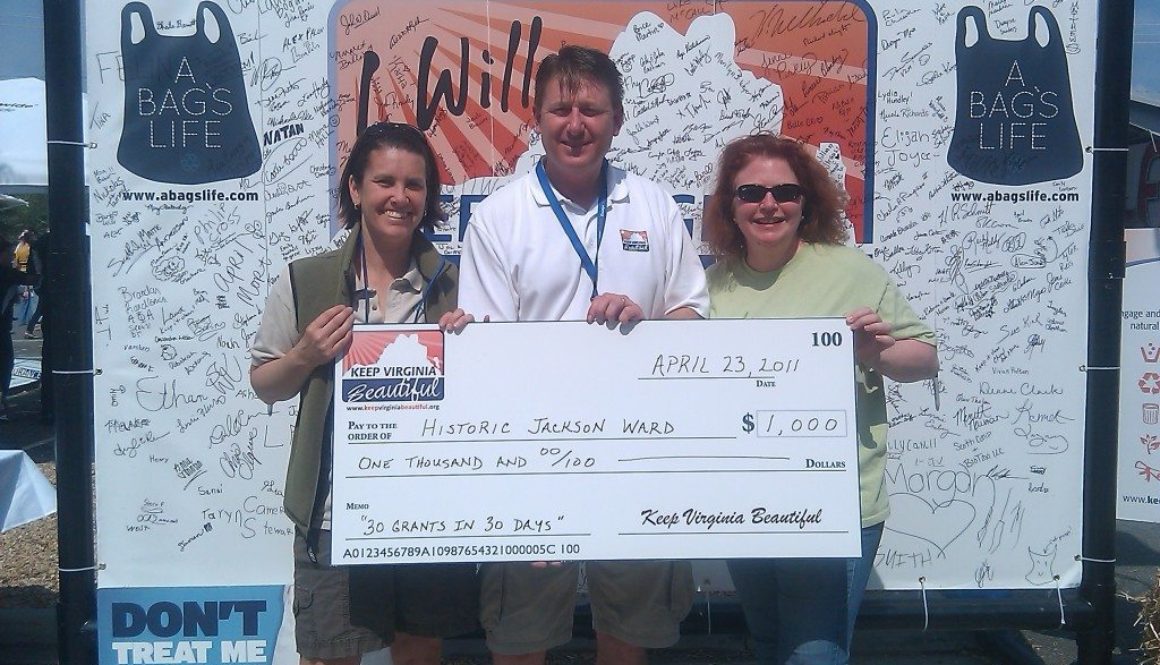
 Friends of Bryan Park is a nonprofit organization founded in 1994 to protect and improve Bryan Park, a 266-acre park in Northside Richmond. Its members are residents, environmentalists, Master Naturalists, and recreation users. Several hundred people visit Bryan Park each day, yet there are no recycling facilities in the park. Grant funds provided by Keep Virginia Beautiful will be used to start the Bryan Park Recycling Program.