Want an excuse to skip raking and bagging all the leaves this Autumn? There are many good reasons to stop doing this seasonal chore. Leaves are valuable to wildlife, your plants and lawn, and play an important part in a sustainable environment.
What you see as a messy lawn or an unkept yard is seen as a buffet for a whole host of wildlife! Earthworms, millepedes, and snails eat the fallen leaves for the nutrients they contain. This fattens up the insects and makes them a tasty meal for many birds such as nuthatches, robins, blue jays, and bluebirds.
The leaves that are left all winter are also a haven for next year’s pollinators, as butterflies and moths lay their eggs in the leaf litter. The Luna moth and other species spend their winter in cocoons and rely on the fallen leaves for camouflage, so they’re not eaten by predators. Turtles, toads and others also enjoy the safety and protection of leaf litter.
For your lawn, it’s easier and yields more benefits if you mulch or mow the leaves and leave them on your grass, as
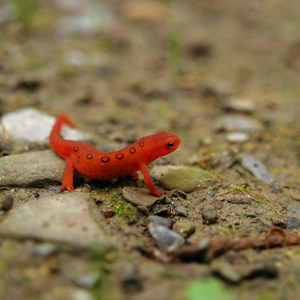
Easter (red-spotted) Newt
long as they’re not so thick that they block the sunlight from the turf all winter. Virginia Tech states in its Lawn Leaf Management pamphlet that using a rotary or mulching mower as a leaf management tool has proven to be a relatively cost effective and timesaving means of leaf disposal and it increases soil organic matter content.
If you’re just not able to adjust to a leafy landscape, consider blowing your leaves into your dormant vegetable beds and under bushes in your flower beds. You could also send them to the outer edges of your property, maybe at a wooded edge or behind a shed, to create a wildlife oasis or two. Just keep the leaves away from roadways, storm drains, and hardscape paths. Virginia Tech also has a pamphlet for Landscaping for Less in the Landfill.
Leaves are a valuable part of the landscape that provides nutrients for your lawn and landscape, food insects and birds, and shelter for pollinators. Best of all, you can avoid the time-consuming chore of putting all those leaves in plastic bags — which is good for you and good for the environment!
One of thirty grants awarded throughout Virginia in June as part of our 12th Annual “Green Grants” Program is awarded to Sustainability Matters for their “Mowing for Monarchs” Initiative.
Sustainability Matters is a grassroots nonprofit organization rooted in the rural Shenandoah Valley that cultivates community through conservation education. It aims to empower community members to change the environment and their own lives for the better. Since its founding in 2018, it has hosted over 200 education and outreach programs!
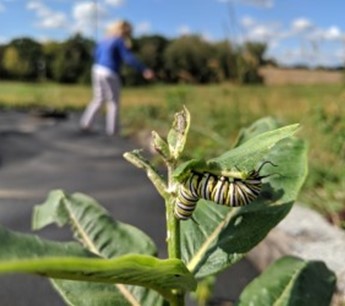
Like most landfills, the Shenandoah County landfill has many open areas that are mowed twice annually, usually during the summer. Originally planted with turfgrass, the fields have, over the years, become a mixture of the original grass, vital native wildflowers that have self-sown, and invasive plants. Among the native plants is a particularly strong seedbank of common milkweed (Asclepias syriaca) that is the main host for monarch butterflies.
Unfortunately, under current practices, the milkweed is mowed down just when the monarchs most need it…and the mowing itself likely kills thousands of monarchs and monarch larvae.
To help reframe the mowing schedule at the Shenandoah County landfill to accommodate monarch butterflies’ lifecycles, Sustainability Matters has been awarded a $1,000 Green Grant. Funding will be utilized to perform a comprehensive, season-long survey of the Shenandoah County landfill fields, documenting the variety and relative concentrations of native and invasive plants, as well as of monarchs and other insects.
The survey will be conducted by over a dozen Sustainability Matters volunteers, high school ecology students, and professional entomologists. The results will help inform an ideal “Mowing for Monarchs” schedule for the landfill.
The results from the study will also help produce a template for other sites with a similar situation, thus scaling the impact of positive benefits. This is a win for native plants, pollinators of all kinds, and the beautiful monarch butterflies.
Congratulations to today’s award of our 2021 Green Grants, Sustainability Matters, in Shenandoah County, who will receive a grant award of $1000 for its Community Beautification project.
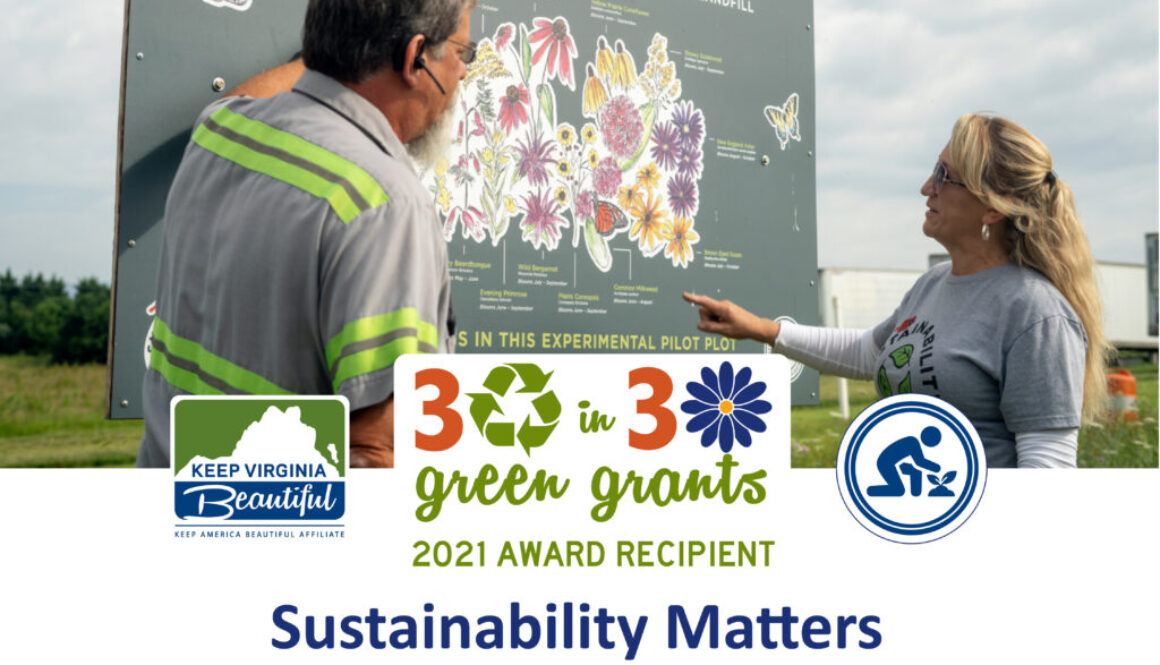
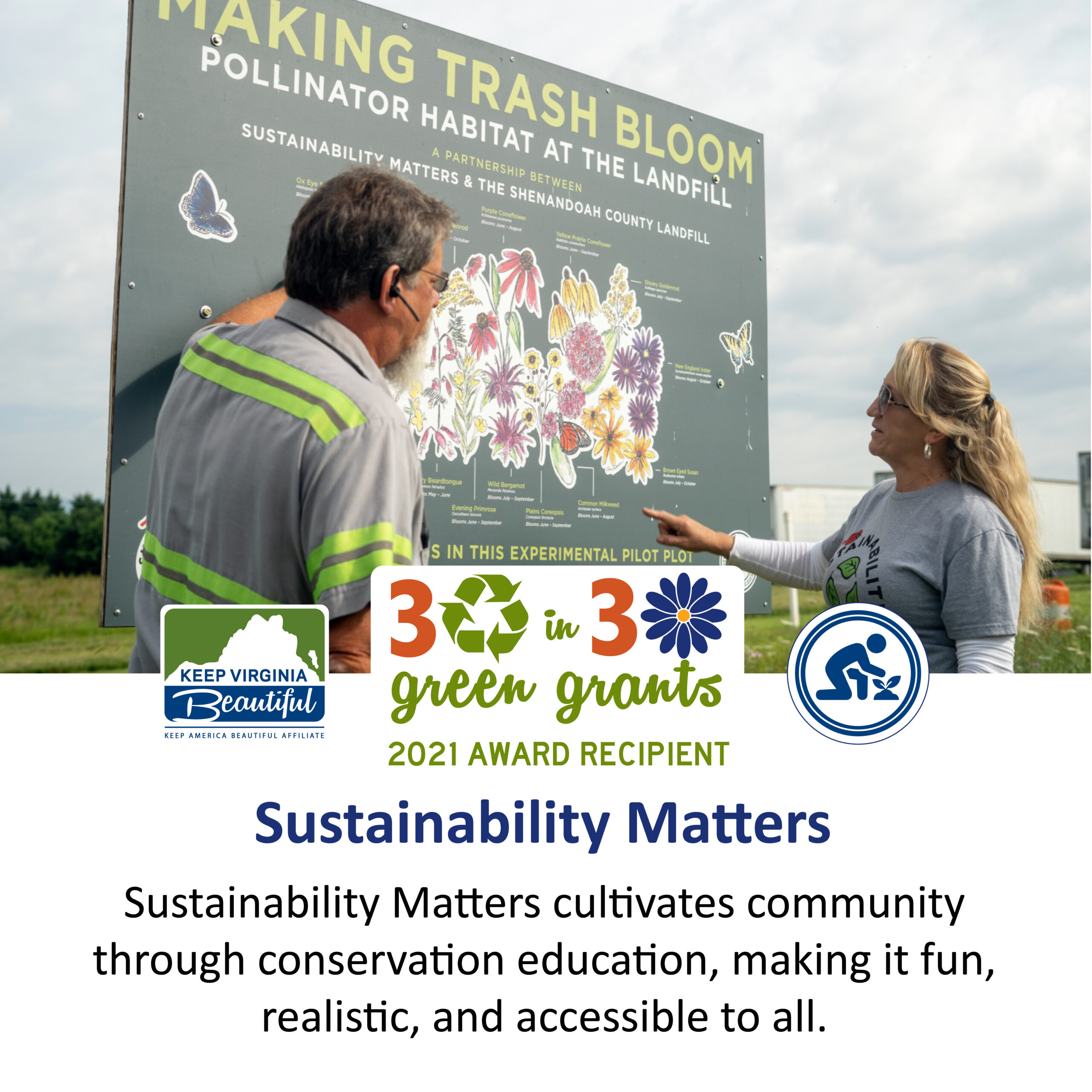
Sustainability Matters is a grassroots organization in rural Shenandoah Valley that provides knowledge, motivation, and a peer support to landowners, farmers, and small business owners, enabling them to implement positive environmental practices, support pollinators and wildlife, and grow their own food. They recently launched the project “Making Trash Bloom,” an initiative to plant landfill trash cells with native perennial meadows instead of turf grass. Landfills seal a 5-acre trash cell every 3-5 years, and the land can never be used to grow crops or be planted with trees. Turf grass, the current preference for planting trash cells, has little ecological value.
The plan for the Community Beautification project from Sustainability Matters is to plant native wildflowers on completed trash cells instead of turf grass, turning this under-used area into a crucial habitat for wildlife and pollinators. It will also be a beautiful area for the public to see as they go to or pass by the landfill. Grant funds will be used to purchase seeds and planting supplies for blossoming gardens at landfills.
Every year, government, non-profit, civic and service organizations in Virginia were invited to apply for grants for $500 to $1,000 describing how they plan to tackle an environmental concern in their community regarding Litter Prevention, Recycling, Cigarette Litter Prevention, or Community Beautification. Since 2011, Keep Virginia Beautiful has provided $254,500 for 320 different environmental programs and projects all across the Commonwealth, due to the generosity of their partnership with Altria, as well as additional support from Coca-Cola, WestRock and Keep America Beautiful.
So. How was your Holiday? You hopefully spent some time with family and friends. You hopefully got to indulge in some delicious foods. You hopefully got to share in some gift giving. What did you get this year? More importantly, what was the ecological impact of your gift?
The number one item on many wish lists this year was a gadget. For many it was a new smart phone. Almost 7 million Android and iOS devices were activated on Christmas day alone. This leads to 2 questions: what is in your current phone and what are you doing with your old one?
We’ve shared with you before about the hazardous chemicals that go into making your clever little device. Tasty things like arsenic, cadmium, lead, nickel, mercury, and copper. This is in addition to the plastics, glass, and light metals that go into the physical body of the phone. China is a leading exporter of “rare earth” minerals. It produces about 95% of the elements needed in everything from iPods to low-emission cars. China doesn’t exactly have the best environmental record. You may recall the week around Thanksgiving that no flights left or came into Beijing. Too much smog.
We’ve also announced a couple of e-cycling days that many of you took advantage of. Much has been made of the environmental and societal impact of the gold industry. Well, gold and silver are two elements found in the little circuit boards of your little gadget. If you give someone the opportunity to recycle the shiny stuff out of your phone, that’s that much less that would have to be mined. 1 tonne (about 2200 pounds) of used cell phones yields about 300 grams of gold. While that doesn’t seem like much, it equates to a little over 200,000 pounds of stuff that wouldn’t have to be dug up. Many electronics retailers have programs to recycle your batteries, also. Batteries are high on the nasty list of electronic waste. Remember, 70% of the toxic stuff in the landfill is from gadgets. If you’re smart, you’ll get a cool case, like the Eton Mobius. It’s lightweight and has a solar panel on the back. Set your phone in the window and increase your talk time by a factor of 2! A solarsmartphone!
Perhaps you got some cool new togs for a gift? Was it a necktie, or a sweater with reindeer on it, or a scarf in your least favorite color? For many of you it may have been jeans. Just to pick on a product.
The primary crop used to make jeans is cotton. We like cotton. Nice, soft, organic, fluffy, cotton. Cotton is, however, a tricky crop. It is highly susceptible to pests and is very thirsty. Most of the cotton that is used for clothing is grown in countries like Pakistan, India, and China. About 300 million people work in the cotton trade, and 90% of them are in developing countries. Here’s where it gets tricky: Because of the need for pesticides to keep the cotton “healthy”, it is estimated that 1/6 of all of the pesticides used worldwide are used for just that. Most developing countries don’t have the same concerns about pesticides that we do. About half of the chemicals sprayed on cotton actually stay on the plant, while the other half goes (you guessed it), into the water supply. That water supply is needed to quench the thirsty cotton plants. A lot of water. It takes about 20 bathtubs of water to grow enough cotton to make one pair of jeans.
Have you ever been into crosswords? You’ve probably come across this one: “vast inland sea. 4 letters”. If you guessed “Aral” you’re partially right. Up until around 1960, the Aral Sea in Uzbekistan was the 4th largest inland sea in the world. What happened in 1960? It was diverted to irrigate the deserts around it for cotton growth. By 2000 it had become 2 smaller inland seas, and today the area is mostly desert.
196420002010
We hate to pick on China, but it is where over 40% of all of the blue jeans sold in the United States start their journey. The majority of them are made in Xintang, which is in Southern China. It churns out over 250 million pairs every year. They start off with a great deal of processing and dying. To do this they use a lot of water and a lot of tasty chemicals, many of which end up in their river. Many of these chemicals contain some of the same savory metals and minerals that go into your gadget, like arsenic, copper, and mercury. Once your soon-to-be-favorite jeans are sufficiently blued, off they go to the river. If you’ve got a nice version of Google Earth, you can actually see where the river goes from a nice color to a dark blue.
So what do you do?
Educate yourself. Many manufacturers are becoming more aware and responsible about their impact on the earth and on society. Take Levi’s, for example. A few years ago they took a long, hard look in the mirror and realized that a pair of their jeans was worth about a swimming pool of water. Now, they can’t change the fact that you’re going to wash the heck out of them, or sit in the tub to make them fit just so, but they can change how they make them. They have a line of jeans called ”Water<Less” that uses 28% less water to make than regular jeans, and they cost about the same as a normal pair. Other manufacturers are examining ways to cut pesticide use, the amount of dye, the materials for zippers and rivets, and other things. Even simple steps like examining the pattern used, makes a difference. If you can cut the raw material more efficiently you can eliminate scraps and therefore need less processed material, less water, fewer chemicals, less cotton…you know, pay it backwards.
There are also several websites and apps that you can use to do your homework. You might as well put that new gadget to good use. A good place to start is with the Organic Consumers Association. They’re primarily about agriculture, but keep up on what farmers are putting into the ground, so a good source of info.
We also like the Better Cotton Initiative. This one gets kind of technical, but it removes any doubts about what the issue is and the steps needed to improve the situation.
Our favorite is the GoodGuide. It has a whole host of items under review, and looks at them from a variety of impact areas. Is it sustainable? Is it manufactured using fair labor practices? Do the growers and laborers see some equity? Does it ruin the environment to make/transport/sell/dispose of this product? From personal care to pet food, from detergents to dishwashers, they’re rated. They even have a listing of companies that are rated. Best of all, GoodGuide has a mobile app, so you can determine the impact of the phone that you’re using to shop for jeans to wear while you’re on your way to recycle your old cell phone.
It’s nice how that goes full circle, isn’t it. A yin and yang of environmental appropriate.
 Want an excuse to skip raking and bagging all the leaves this Autumn? There are many good reasons to stop doing this seasonal chore. Leaves are valuable to wildlife, your plants and lawn, and play an important part in a sustainable environment.